RESEARCH PAPER

Effects of Long-Term Storage on Fermentation Characteristics, Nutritional Value and in Vitro Degradation Characteristics of Ensiled Alfalfa-Based Fermented Total Mixed Ration

  • GAO Run , 1, 2 ,
  • SUN Zhiqiang 2 ,
  • WANG Lei 2 ,
  • WANG Guoliang 1 ,
  • BASIGALUP Daniel 1, 3 ,
  • YU Zhu , 2, *
Expand
  • 1 Shandong Engineering Research Centre for Ecological Horticultural Plant Breeding, Institute of Leisure Agriculture, Shandong Academy of Agricultural Sciences, Ji’nan 250100, China
  • 2 College of Grassland Science and Technology, China Agricultural University, Beijing 100193, China
  • 3 National Institute of Agricultural Technology, Manfredi 5988, Argentina
* professor, E-mail:

Received date: 2025-10-18

  Online published: 2026-06-13

Abstract

This experiment investigated the effects of long-term storage on the characteristics, nutritional value and in vitro degradation characteristics of ensiled alfalfa-based fermented total mixed ration (FTMR). A total of six ensiled alfalfa-based FTMR formulas were designed in this experiment: early-finishing (formula 1), mid-finishing (formula 2) and late-finishing (formula 3) for beef cattle, and early-finishing (formula 4), mid-finishing (formula 5) and late-finishing (formula 6) for mutton sheep. Each formula was prepared with six replicates and stored for 6 and 12 months, respectively. After stored for 6 and 12 months, the samples were collected upon opening to determine fermentation indicators, nutrient contents and in vitro degradation characteristics. The results showed as follows: 1) except for formula 4, the pH of formula 1, 2, 3, 5 and 6 stored for 12 months were significantly or extremely significantly lower than each of those stored for 6 months (P<0.05 or P<0.01). The lactic acid (LA), acetic acid (AA) and ammonia nitrogen (NH3-N) contents of all formulas stored for 12 months were significantly or extremely significantly higher than each of those stored for 6 months (P<0.05 or P<0.01). The propionic acid (PA) content and Fleig’s score of formulas 2, 3, 5 and 6 stored for 12 months were significantly or extremely significantly higher than each of those stored for 6 months (P<0.05 or P<0.01). 2) There was no significant difference in the dry matter (DM) and crude protein (CP) contents among all formulas stored for different time (0, 6 and 12 months) (P>0.05). The neutral detergent fiber (NDF) content of formula 3 stored for 6 and 12 months was significantly lower than that stored for 0 month (P<0.05). The NDF and acid detergent fiber (ADF) contents of formula 6 stored for 0 and 6 months were significantly higher than those stored for 12 months (P<0.05), and the total digestible nutrients (TDN) and relative feeding value (RFV) were significantly lower than those stored for 12 months (P<0.05). 3) The in vitro dry matter digestibility (IVDMD) and in vitro crude protein digestibility (IVCPD) of formula 3 stored for 6 months were significantly higher than those stored for 0 months (P<0.05), and the IVDMD and in vitro NDF digestibility (IVNDFD) of formula 6 stored for 6 months were significantly higher than those stored for 0 month (P<0.05). The cumulative gas production after 12 h of in vitro digestion of formula 1 stored for 6 months was extremely significantly lower than that stored for 0 month (P<0.01), while the cumulative gas production after 12 h in vitro digestion of formulas 2 and 3 stored for 6 months was significantly higher than that stored for 0 month (P<0.05). The cumulative gas production after 24 h of in vitro digestion of formula 5 stored for 6 months was significantly lower than that stored for 0 month (P<0.05). The cumulative gas production after 48 h of in vitro digestion of formulas 4 and 5 stored for 6 months was significantly lower than that stored 0 month (P<0.05). The pH of the digestive solution after 48 h of in vitro digestion of formulas 3, 4, 5 and 6 stored for 6 months were significantly higher than those stored for 0 month (P<0.05). In conclusion, storage for 12 months can reduce the pH of each ensiled alfalfa-based FTMR, increase LA, AA and PA contents, but also increase NH3-N content, exacerbate protein degradation; storage for 6 months can reduce the NDF content of the ensiled alfalfa-based FTMR for the late-finishing of beef cattle (formula 3) and increase its IVDMD and IVCPD; storage for 12 months can reduce the NDF and ADF contents of the ensiled alfalfa-based FTMR for the late-finishing of mutton sheep (formula 6) and increase its TDN content, RFV, IVDMD and IVNDFD.

Cite this article

GAO Run , SUN Zhiqiang , WANG Lei , WANG Guoliang , BASIGALUP Daniel , YU Zhu . Effects of Long-Term Storage on Fermentation Characteristics, Nutritional Value and in Vitro Degradation Characteristics of Ensiled Alfalfa-Based Fermented Total Mixed Ration[J]. Chinese Journal of Animal Nutrition, 2026 , 38(6) : 4563 -4575 . DOI: 10.12418/CJAN2026.366

发酵全混合日粮(FTMR)是根据反刍动物营养需要,利用搅拌机将粗饲料、精饲料、维生素、矿物质等原料按照科学配比混合均匀,使用拉伸膜裹包机打捆密封后厌氧贮藏的饲粮[1-2],相较于普通全混合日粮(TMR),其能提高饲粮的保存期限和商品属性[3]。FTMR能有效保留原料的营养特性并延长贮存周期,然而在实际生产中常面临长期贮存的需求——例如跨季节供应或战略储备,饲粮可能需存放数月甚至更久。苜蓿作为一种优质豆科牧草,因其高蛋白质含量、丰富的可消化纤维及必需氨基酸,常被用作高产奶牛、肉牛和肉羊等反刍动物的重要粗饲料来源[4]。然而,目前关于长期贮藏条件下青贮苜蓿型FTMR的发酵特性、营养成分的动态变化规律及其体外降解特性的研究仍较为有限。
现有研究表明,在厌氧贮藏过程中饲料会发生复杂的生物化学变化:一方面,厌氧环境能抑制有害微生物繁殖,但乳酸菌持续代谢产生的有机酸积累可能导致pH下降,进而引发细胞壁组分降解[5];另一方面,长时间发酵可能促进美拉德反应产物的形成,改变蛋白质结构与可用性[6]。有研究表明,FTMR在厌氧贮藏后的饲用价值会提高,是因为在贮藏过程中微生物会降解碳水化合物,破坏纤维结构,从而有利于反刍动物瘤胃的消化降解[7]。另有研究表明,FTMR能提高藏羊的屠宰性能、中性洗涤纤维(NDF)和半纤维素表观消化率,降低腹部的脂肪沉积,起到改善背最长肌肉色和营养价值的作用[8]。此外,由于FTMR含有淀粉等易变质成分,在厌氧贮藏过程中其菌群活性较单纯青贮更为复杂,贮藏期延长是否会加剧二次发酵风险尚存争议。这些变化不仅可能影响FTMR本身的稳定性,如氨态氮(NH3-N)含量、体外累积产气量,还可能显著改变其营养组成,如NDF、酸性洗涤木质素(ADL)比例,同时,体外降解特性也可能发生改变。体外降解特性作为评估饲料有效性的重要手段,通过模拟瘤胃环境并量化微生物对底物的分解效率,能够解析长期贮藏对饲料实际利用价值的影响[9]。张琬倩等[10]研究表明,厌氧贮藏能改善饲用品质,提高体外干物质消化率(IVDMD),改变瘤胃发酵模式,提高FTMR的利用率并减少反刍动物甲烷排放量。
尽管已有很多研究关注短、中期(<90 d)贮藏对常规青贮苜蓿品质的影响,但针对青贮苜蓿型FTMR在长期(≥180 d)贮藏条件下的系统性评价尚未见报道。因此,明确长期厌氧贮藏条件对青贮苜蓿型FTMR的影响,对于制定科学的库存周转策略、保障反刍动物营养的精准供给具有重要实践意义。本研究旨在系统探讨中、长期贮藏对青贮苜蓿型FTMR发酵特性、营养价值与体外降解特性的影响,以期为优化FTMR供应链管理提供数据支持。

1 材料与方法

1.1 试验材料

本试验所用青贮苜蓿的调制方法为:在苜蓿原料中添加2%FW糖蜜和1×10⁶ CFU/g FW植物乳杆菌后进行青贮。所用糖蜜为甘蔗制糖后的副产物,主要成分为蔗糖;所用植物乳杆菌由中国农业大学草业科学与技术学院牧草加工实验室筛选,活菌数为3.27×10¹¹ CFU/g。青贮苜蓿的干物质(DM)、粗蛋白质(CP)、NDF和酸性洗涤纤维(ADF)含量分别为51.49%、17.57%DM、39.15%DM和30.63%DM。

1.2 试验设计

试验针对肉牛育肥前(配方1)、中(配方2)和后期(配方3)与肉羊育肥前(配方4)、中(配方5)和后期(配方6)营养需求设计6种青贮苜蓿型FTMR,其组成及营养水平见表1。按照表1所示配方称取青贮苜蓿、其他粗饲料、精饲料及预混料等,然后使用搅拌机将其混合均匀;随后,利用全自动青贮打捆包膜一体机将制备好的FTMR进行打捆密封,每个裹包的重量约70 kg。每个贮藏时间各配方均设置3个重复,共36个(6个配方×2个贮藏时间×3个重复)裹包。同时,每个配方保留3份混合均匀的样品作为贮藏0个月的样品。制备好的青贮苜蓿型FTMR裹包贮藏在干燥且地势较高的仓库,分别贮藏6和12个月后进行取样,测定发酵指标、营养成分含量和体外降解特性。
表1 青贮苜蓿型FTMR组成及营养水平(干物质基础)

Table 1 Composition and nutrient levels of ensiled alfalfa-based FTMR (DM basis)

项目
Items
配方1
Formula 1
配方2
Formula 2
配方3
Formula 3
配方4
Formula 4
配方5
Formula 5
配方6
Formula 6
原料 Ingredients/%
青贮苜蓿 Ensiled alfalfa 35.0 27.0 22.0 24.0 22.0 20.0
燕麦干草 Oat hay 16.0 21.5 21.0 23.0 19.0 15.0
玉米青贮 Corn silage 34.0 26.5 22.0 23.0 19.0 15.0
玉米粉 Corn powder 12.0 23.3 33.0 28.0 35.5 42.5
豆粕 Soybean meal 1.8 0.5 0.5 0.5 3.0 6.0
食盐 NaCl 0.6 0.6 0.8 0.8 0.8 0.8
预混料 Premix1) 0.6 0.6 0.7 0.7 0.7 0.7
合计 Total 100.0 100.0 100.0 100.0 100.0 100.0
营养水平 Nutrient levels2)
粗蛋白质 CP/% 12.35 11.12 10.68 10.85 11.80 12.97
中性洗涤纤维 NDF/% 40.45 38.03 34.64 36.61 32.69 28.66
酸性洗涤纤维 ADF/% 27.86 25.41 22.64 24.18 21.41 18.64
总可消化养分 TDN/% 66.60 68.64 70.64 69.39 71.59 73.74
消化能 DE/(MJ/kg) 11.83 12.31 12.74 12.48 12.92 13.31
代谢能 ME/(MJ/kg) 10.09 10.40 10.70 10.51 10.84 11.14
粗精比 F∶C ratio 85∶15 75∶25 65∶35 70∶30 60∶40 50∶50

1)每千克预混料提供 Each kilogram of premix provides the following:VA 300 000 IU,VD3 60 000 IU,VE 1 000 IU,VB1 750 mg,VB3 750 mg,Cu 500 mg,Fe 500 mg,Zn 1 500 mg,Mn 1 000 mg,Co 5 mg,Se 5 mg,I 20 mg,S 12 000 mg。
2)粗蛋白质、中性洗涤纤维、酸性洗涤纤维、总可消化养分、代谢能和消化能均依据NRC(2016)饲料原料成分表中各原料相应数值及其在配方中的占比计算得出。CP, NDF, ADF, TDN, ME and DE are all calculated based on the respective values of each ingredient in the NRC(2016) feed composition table and their proportions in the formula.

1.3 测定指标及方法

1.3.1 营养成分含量的测定

按照GB/T 6435—2014测定样品的DM含量。将烘干后的样品粉碎过筛(0.42 mm),使用元素分析仪(vario MACRO cube,Elementar,德国)测定总氮(TN)含量,CP含量为6.25×TN含量;采用Van Soest等[14]报道的方法测定NDF和ADF含量。
总可消化养分(TDN)的计算方法[15]如下:
TDN(% DM)=76.6-0.514×ADF含量(% DM)。
相对饲喂价值(RFV)的计算方法[16]如下:
RFV=DDM(% DM)×DMI(% BW)/1.29;
DDM(% DM)=88.9-0.779×ADF含量(% DM);
DMI(% BW)=120/NDF含量(% DM)。
式中:DDM为可消化干物质;DMI为干物质采食量。

1.3.2 发酵指标的测定

称取10 g FTMR样品置于90 mL蒸馏水中,使用榨汁机匀质1 min,经4层无菌纱布和滤纸过滤后,将滤液低速(3 500×g)离心,取上清液用于发酵指标测定。pH采用酸度计(FE28型,梅特勒-托利多,瑞士)测定。将滤液于4 ℃、高速(10 000×g)离心5 min,取上清液,经0.45 μm水系滤膜过滤后,采用高效液相色谱仪(LC-20A型,岛津,日本)测定乳酸(LA)、乙酸(AA)、丙酸(PA)及丁酸(BA)含量,具体操作参照Tian等[11]的方法。NH3-N含量采用苯酚-次氯酸钠法[12]测定。按以下公式[13]计算费氏评分(Flieg’s score):
费氏评分=220+[2×DM含量(% FW)-15]-40×pH。

1.3.3 体外降解特性的测定

为保证体外模拟环境条件一致、减少因瘤胃液个体差异引起的误差,本试验所用瘤胃液均取自北京窦店恒升牧业科技股份有限公司。于晨饲前,从3头生长状况良好的安格斯瘘管牛瘤胃中采集适量瘤胃液,置于保温瓶中迅速带回实验室。瘤胃液经4层无菌纱布过滤后,注入预先于39 ℃预热的收集瓶中,并持续通入二氧化碳。准确称取约0.5 g FTMR样品(干重)于F57滤袋中(每个样品重复6次),使用封口机封口。参照Menke等[17]的方法,采用Daisy Ⅱ体外模拟培养箱(ANKOM Technology,美国)对待测样品体外消化48 h后,测定消化液的pH,将残渣烘干后称重并测定残渣CP、NDF、ADF含量,按照如下公式计算IVDMD、体外粗蛋白质消化率(IVCPD)、体外中性洗涤纤维消化率(IVNDFD)及体外酸性洗涤纤维消化率(IVADFD):
IVDMD(%)=100×[样品干重(g)-残渣干重(g)]/样品干重(g);
IVCPD(%)=100×[样品CP含量(% DM)-残渣CP含量(% DM)]/样品CP含量(% DM);
IVNDFD(%)=100×[样品NDF含量(% DM)-残渣NDF含量(% DM)]/样品NDF含量(% DM);
IVADFD(%)=100×[样品ADF含量(% DM)-残渣ADF含量(% DM)]/样品ADF含量(% DM)。
采用ANKOM RFS产气测量系统(ANKOM Technology,美国)测定体外产气量。称量约1 g FTMR样品(干重)于发酵瓶(310 mL)中,每小时记录1次产气量数据,持续48 h,具体操作参照Xie等[18]的方法进行。

1.4 数据分析

原始数据使用Excel 2021进行整理后,采用SAS 9.4软件进行统计分析。不同贮藏时间(6、12个月)FTMR的发酵指标,体外养分消化率,体外消化12、24及48 h累积产气量以及体外消化48 h消化液pH的差异分析均采用t检验;不同贮藏时间(0、6、12个月)FTMR的营养成分含量和RFV采用单因素方差分析(one-way ANOVA)结合Duncan氏法进行差异分析。采用一般线性模型(GLM)程序对体外消化累积产气量进行双因素方差分析,分析贮藏时间、体外消化时间及其交互作用对体外累积产气量的影响。以P<0.05为差异显著,P<0.01为差异极显著。所有数据均以平均值±标准差表示。

2 结果

2.1 长期贮藏青贮苜蓿型FTMR的发酵特性

长期贮藏对青贮苜蓿型FTMR发酵指标的影响见表2。配方1,贮藏6个月的pH极显著高于贮藏12个月(P<0.01);贮藏12个月的LA、AA和NH3-N含量均极显著高于贮藏6个月(P<0.01);2个贮藏时间的PA含量和费氏评分无显著差异(P>0.05),且均未检测出BA。配方2,贮藏6个月的pH亦极显著高于贮藏12个月(P<0.01);贮藏12个月的LA和PA含量均极显著高于贮藏6个月(P<0.01),且AA、NH3-N含量和费氏评分显著高于贮藏6个月(P<0.05);2个贮藏时间的BA含量则无显著差异(P>0.05)。配方3,贮藏6个月的pH极显著高于贮藏12个月(P<0.01);贮藏12个月的LA、AA、PA、NH3-N含量均极显著高于贮藏6个月(P<0.01),且费氏评分显著高于贮藏6个月(P<0.05);2个贮藏时间均未检测出BA。配方4,贮藏12个月的LA、AA和NH3-N含量均极显著高于贮藏6个月(P<0.01),而pH、PA含量及费氏评分与贮藏6个月无显著差异(P>0.05);2个贮藏时间均未检测出BA。配方5,贮藏6个月的pH极显著高于贮藏12个月(P<0.01);贮藏12个月的LA、AA、PA、NH3-N含量及费氏评分均极显著高于贮藏6个月(P<0.01);2个贮藏时间的BA含量则无显著差异(P>0.05)。配方6,贮藏6个月的pH显著高于贮藏12个月(P<0.05);贮藏12个月的LA、AA、PA含量均极显著高于贮藏6个月(P<0.01),同时NH3-N含量和费氏评分均显著高于贮藏6个月(P<0.05);2个贮藏时间的BA含量则无显著差异(P>0.05)。
表2 长期贮藏对青贮苜蓿型FTMR发酵指标的影响

Table 2 Effects of long-term storage on fermentation indicators of ensiled alfalfa-based FTMR

项目
Items
贮藏时间
Storage
time/月
pH 乳酸
LA/%DM
乙酸
AA/%DM
丙酸
PA/%DM
丁酸
BA/%DM
氨态氮
NH3-N/%TN
费氏评分
Fleig’s score


配方1
Formula 1
6 4.41±0.03A 3.38±0.29B 0.32±0.02B 0.00±0.00 0.00±0.00 3.08±0.22B 121.19±1.59
12 4.18±0.01B 7.68±0.11A 3.51±0.07A 0.68±0.44 0.00±0.00 6.57±0.02A 125.68±0.48
PP-value 0.002 <0.001 <0.001 0.263 0.004 0.054


配方2
Formula 2
6 4.15±0.01A 2.74±0.25B 0.45±0.03b 0.00±0.00B 0.01±0.01 3.44±0.09b 142.23±0.80b
12 3.93±0.04B 9.82±0.38A 2.21±0.20a 1.54±0.08A 0.00±0.00 4.91±0.34a 149.89±1.70a
PP-value 0.007 <0.001 0.012 0.003 0.423 0.014 0.015


配方3
Formula 3
6 4.47±0.03A 2.64±0.04B 0.34±0.01B 0.11±0.11B 0.00±0.00 2.60±0.23B 133.76±1.70b
12 4.15±0.03B 6.58±0.23A 2.48±0.03A 1.78±0.00A 0.00±0.00 5.69±0.01A 142.35±0.80a
PP-value 0.002 <0.001 <0.001 0.004 0.005 0.010


配方4
Formula 4
6 4.21±0.01 2.62±0.09B 0.40±0.02B 0.00±0.00 0.00±0.00 2.45±0.05B 152.11±0.99
12 4.17±0.02 6.41±0.20A 1.00±0.06A 0.86±0.37 0.00±0.00 3.29±0.04A 152.86±0.53
PP-value 0.222 <0.001 0.001 0.143 <0.001 0.540


配方5
Formula 5
6 4.35±0.02A 2.71±0.02B 0.23±0.03B 0.00±0.00B 0.05±0.05 2.15±0.06B 147.81±0.88B
12 3.92±0.02B 8.45±0.24A 1.20±0.03A 1.58±0.03A 0.00±0.00 3.44±0.15A 164.09±2.13A
PP-value <0.001 0.002 <0.001 <0.001 0.423 0.001 0.002


配方6
Formula 6
6 4.21±0.06a 2.99±0.52B 0.35±0.10B 0.02±0.01B 0.03±0.03 2.41±0.42b 150.58±2.38b
12 3.88±0.01b 9.19±0.28A 1.45±0.11A 1.79±0.06A 0.00±0.00 3.89±0.30a 164.60±3.14a
PP-value 0.028 0.001 0.002 <0.001 0.423 0.045 0.024

同一配方、同一指标的数据,肩标不同小写字母表示差异显著(P<0.05),不同大写字母表示差异极显著(P<0.01)。下表同。

For the same formula and the same indicator, values with different lowercase superscript letters indicate significant difference (P<0.05), while with different uppercase superscript letters indicate extremely significant difference (P<0.01). The same as below.

2.2 长期贮藏青贮苜蓿型FTMR的营养价值

长期贮藏对青贮苜蓿型FTMR营养成分含量和相对饲喂价值的影响见表3。配方1、配方2、配方4和配方5贮藏0个月与贮藏6、12个月的DM、CP、NDF、ADF和TDN含量及RFV均无显著差异(P>0.05);配方3贮藏6、12个月的NDF含量显著低于贮藏0个月(P<0.05),不同贮藏时间下其他营养成分含量及RFV均无显著差异(P>0.05);配方6贮藏12个月的NDF和ADF含量显著低于贮藏0和6个月(P<0.05),TDN含量和RFV则显著高于贮藏0和6个月(P<0.05)。
表3 长期贮藏对青贮苜蓿型FTMR营养成分含量和相对饲喂价值的影响

Table 3 Effects of long-term storage on nutrient contents and RFV of ensiled-alfalfa based FTMR

项目
Items
贮藏时间
Storage
time/月
干物质
DM/%FW
粗蛋白质
CP/%DM
中性洗
涤纤维
NDF/%DM
酸性洗
涤纤维
ADF/%DM
总可消化养分
TDN/%DM
相对饲
喂价值
RFV


配方1
Formula 1
0 46.48±0.26 12.77±0.16 38.39±0.55 25.01±0.89 63.75±0.46 168.27±3.08
6 46.23±1.23 12.64±0.31 37.77±0.48 24.23±1.07 64.15±0.55 172.58±3.87
12 43.87±0.06 12.88±0.11 34.91±1.31 23.40±0.85 64.57±0.44 188.99±9.06
PP-value 0.087 0.421 0.118 0.591 0.591 0.161


配方2
Formula 2
0 52.43±0.20 11.72±0.08 34.95±0.75 21.80±0.80 65.39±0.41 191.66±5.63
6 51.55±0.27 11.89±0.10 35.06±0.83 21.02±0.76 65.79±0.39 192.72±6.27
12 50.98±0.29 11.97±0.09 30.97±1.94 19.80±1.87 66.42±0.96 222.82±17.26
PP-value 0.061 0.258 0.172 0.600 0.600 0.219


配方3
Formula 3
0 53.71±0.67 11.82±0.47 32.88±0.34a 20.31±0.51 66.16±0.26 206.85±3.25
6 53.71±0.41 11.74±0.25 29.86±0.70b 17.57±1.23 67.57±0.63 234.72±8.26
12 51.74±0.30 11.97±0.19 28.21±0.77b 18.34±0.11 67.17±0.06 246.46±7.08
PP-value 0.066 0.909 0.030 0.123 0.123 0.052


配方4
Formula 4
0 58.07±0.27 11.62±0.06 34.65±1.44 21.29±1.18 65.65±0.61 195.03±10.65
6 57.69±0.26 12.16±0.08 32.66±1.56 20.03±2.05 66.30±1.05 210.07±13.61
12 57.33±0.40 11.73±0.15 28.66±0.56 18.21±0.90 67.24±0.47 242.78±6.88
PP-value 0.426 0.071 0.112 0.464 0.464 0.124


配方5
Formula 5
0 58.26±0.34 12.43±0.21 35.41±1.27 22.49±1.34 65.04±0.69 188.20±9.19
6 58.47±0.52 12.24±0.24 34.97±2.16 21.95±1.33 65.32±0.69 192.93±15.65
12 57.88±0.99 12.57±0.21 27.65±1.39 18.21±1.07 67.24±0.55 252.88±14.98
PP-value 0.817 0.697 0.091 0.196 0.196 0.084


配方6
Formula 6
0 54.39±0.24 12.45±0.17 27.98±1.51a 17.46±0.82a 67.63±0.42b 252.02±15.43b
6 56.92±1.94 13.00±0.41 29.67±1.26a 17.37±0.41a 67.67±0.21b 237.31±11.49b
12 57.33±1.59 12.94±0.17 23.23±0.17b 14.82±0.22b 68.98±0.11a 309.78±2.48a
PP-value 0.241 0.369 0.023 0.034 0.034 0.013

2.3 长期贮藏青贮苜蓿型FTMR的体外降解特性

考虑到FTMR贮藏6个月后其微生物活动与化学成分变化已趋于稳定,为保障关键时间点数据质量,本试验集中资源,选取贮藏6个月的青贮苜蓿型FTMR为代表,进行长期贮藏青贮苜蓿型FTMR体外降解特性的评估。
长期贮藏对青贮苜蓿型FTMR养分体外消化率的影响见表4。配方1、4和5贮藏6个月的IVDMD、IVCPD、IVNDFD和IVADFD与贮藏0个月均无显著差异(P>0.05);配方2贮藏6个月的IVADFD显著高于贮藏0个月(P<0.05),其他养分体外消化率则与贮藏0个月无显著差异(P>0.05);配方3贮藏6个月的IVDMD极显著高于贮藏0个月(P<0.01),IVCPD显著高于贮藏0个月(P<0.05),其他养分体外消化率则与贮藏0个月无显著差异(P>0.05);配方6贮藏6个月的IVDMD极显著高于贮藏0个月(P<0.01),IVNDFD显著高于贮藏0个月(P<0.05),其他养分体外消化率则与贮藏0个月无显著差异(P>0.05)。
表4 长期贮藏对青贮苜蓿型FTMR养分体外消化率的影响(干物质基础)

Table 4 Effects of long-term storage on in vitro digestibility of nutrients of ensiled alfalfa-based FTMR (DM basis) %

项目
Items
贮藏时间
Storage
time/月
体外干物
质消化率
IVDMD
体外粗蛋
白质消化率
IVCPD
体外中性洗涤
纤维消化率
IVNDFD
体外酸性洗涤
纤维消化率
IVADFD


配方1
Formula 1
0 78.09±0.32 89.96±0.40 51.25±0.25 45.02±1.36
6 77.74±0.95 89.78±1.95 52.70±3.50 49.07±2.80
PP-value 0.733 0.934 0.720 0.323


配方2
Formula 2
0 78.66±0.56 89.41±1.05 48.98±1.48 44.04±0.94b
6 80.52±0.98 90.45±0.84 56.31±0.05 51.39±0.60a
PP-value 0.150 0.519 0.127 0.022


配方3
Formula 3
0 78.07±0.36B 87.20±0.76b 47.09±0.04 44.14±0.28
6 80.25±0.43A 90.41±0.57a 44.57±3.68 35.59±8.52
PP-value 0.007 0.041 0.565 0.421


配方4
Formula 4
0 80.28±0.57 89.31±0.10 56.40±4.53 52.95±6.21
6 80.01±0.61 90.05±0.76 50.01±2.07 43.84±3.81
PP-value 0.766 0.511 0.235 0.270


配方5
Formula 5
0 80.21±0.29 88.85±1.17 53.18±2.32 48.70±2.39
6 80.38±0.31 89.98±0.82 55.80±2.30 51.64±1.23
PP-value 0.701 0.536 0.502 0.428


配方6
Formula 6
0 80.47±0.53B 86.82±1.75 41.64±3.12b 37.62±3.06
6 82.59±0.34A 89.79±0.91 51.33±1.10a 43.13±1.32
PP-value 0.007 0.205 0.043 0.174
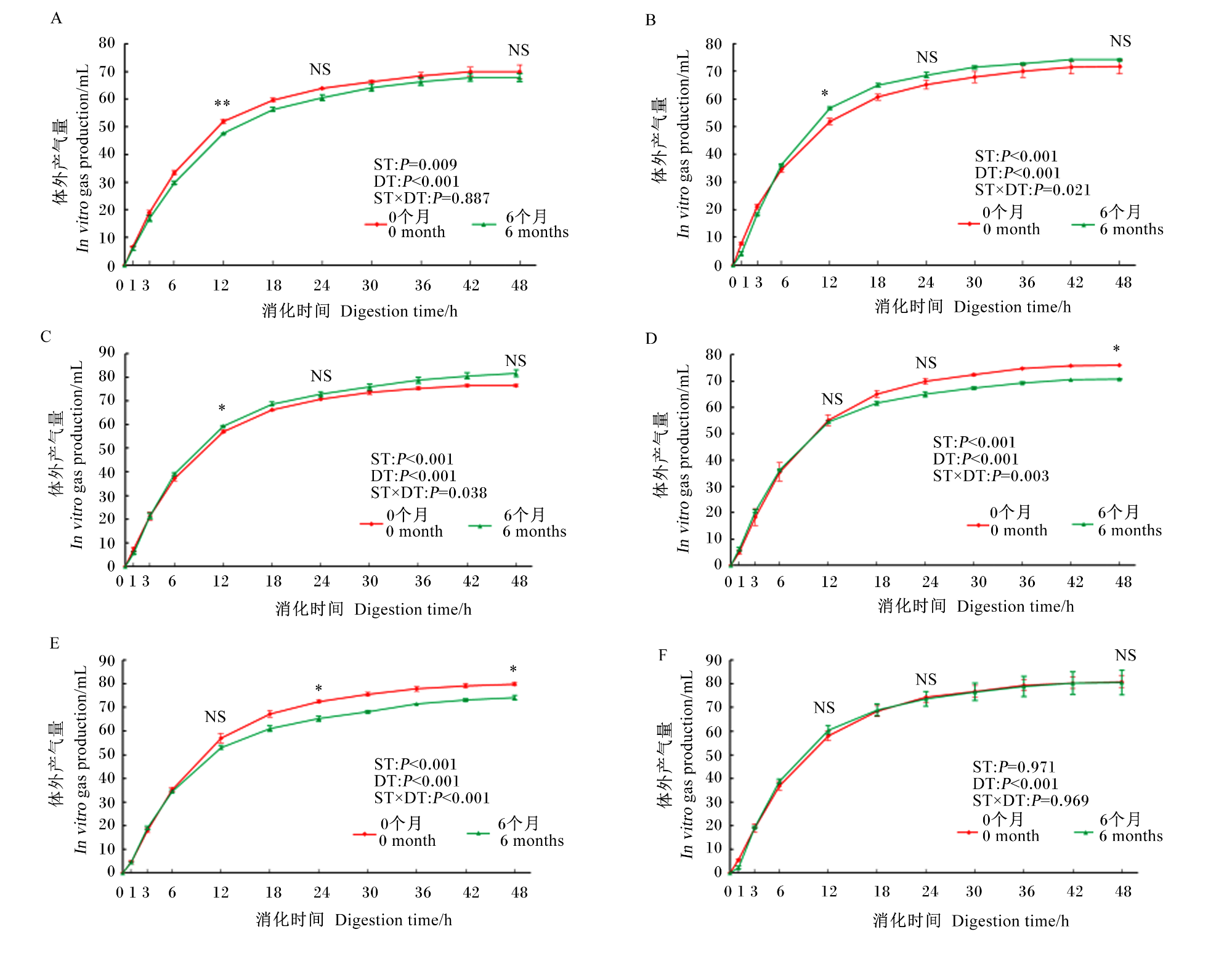
贮藏6个月青贮苜蓿型FTMR体外消化累积产气量变化如图1所示。随体外消化时间的延长,各配方贮藏0和6个月的累积产气量均呈逐渐上升的趋势。配方1体外消化12 h时,贮藏6个月的累积产气量极显著低于贮藏0个月(P<0.01);配方2和3体外消化12 h时,贮藏6个月的累积产气量显著高于贮藏0个月(P<0.05);配方4体外消化48 h时,贮藏0个月的累积产气量显著高于贮藏6个月(P<0.05);配方5体外消化24和48 h时,贮藏0个月的累积产气量显著高于贮藏6个月(P<0.05);配方6体外消化12、24和48 h,贮藏0和6个月的累积产气量均差异不显著(P>0.05)。双因素方差分析显示,贮藏时间对配方1、2、3、4和5的体外消化累积产气量有极显著影响(P<0.01),消化时间对各配方的体外消化累积产气量均有极显著影响(P<0.01);并且,贮藏时间与消化时间的交互作用对配方2和3的体外消化累积产气量有显著影响(P<0.05),对配方4和5的体外消化累积产气量有极显著影响(P<0.01)。
图1 贮藏6个月青贮苜蓿型FTMR体外消化累积产气量变化

A:配方1;B:配方2;C:配方3;D:配方4;E:配方5;F:配方6。ST:贮藏时间;DT:消化时间;ST×DT:贮藏时间与消化时间的交互作用。“**”代表差异极显著(P<0.01);“*”代表差异显著(P<0.05);“NS”代表差异不显著(P>0.05)。下图同。

Fig.1 Changes in cumulative gas production after in vitro digestion of ensiled alfalfa-based FTMR for 6 months storage

A: formula 1; B: formula 2; C: formula 3; D: formula 4; E: formula 5; F: formula 6. ST: storage time; DT: digestion time; ST×DT: interaction between storage time and digestion time. “**” represents extremely significant difference (P<0.01); “*” represents significant difference (P<0.05); “NS” represents no significant difference (P>0.05). The same as below.

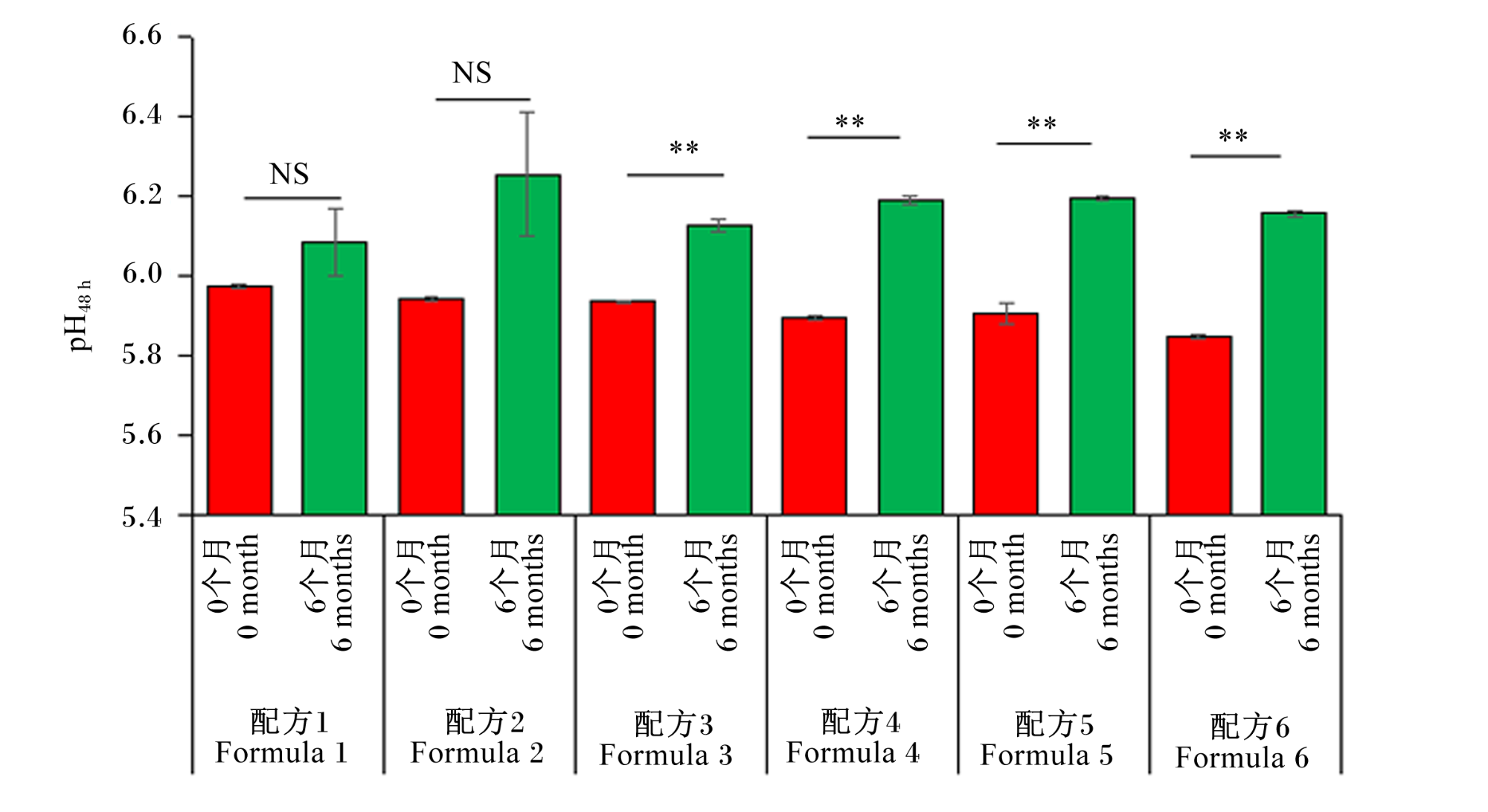
贮藏6个月青贮苜蓿型FTMR体外消化48 h消化液pH变化如图2所示。配方3、4、5和6贮藏6个月体外消化48 h消化液的pH极显著高于贮藏0个月(P<0.01),而配方1和2不同贮藏时间之间则无显著差异(P>0.05)。
图2 贮藏6个月青贮苜蓿型FTMR体外消化48 h消化液pH

Fig.2 Changes in pH of digestion solution after 48 hours in vitro digestion of ensiled alfalfa-based FTMR for 6 months storages

3 讨论

3.1 长期贮藏青贮苜蓿型FTMR发酵特性

研究表明,发酵饲料的pH小于4.2时发酵质量较好[19]。本研究发现,贮藏6个月的FTMR的pH在4.15~4.41,仅配方2的低于4.2,而贮藏12个月的FTMR的pH在3.88~4.18,各配方均低于4.2,且贮藏6个月的LA、AA和PA含量均不同程度地低于贮藏12个月,说明贮藏12个月的FTMR的发酵特性要优于贮藏6个月。有研究表明,燕麦-饲用豌豆裹包FTMR的pH、有机酸含量在贮藏1个月后趋于稳定[20],这与本研究发现的青贮苜蓿型FTMR贮藏6个月后pH缓慢下降,LA、AA和PA含量显著升高的结果不同,可能的原因是2个研究所用的FTMR的组分不同。BA是发酵饲料贮藏失败的重要体现,是由丁酸菌在厌氧条件下发酵LA和糖类而产生的酸类物质,一般认为BA含量超过0.5%DM会导致发酵饲料品质下降[21]。本研究发现,除配方2、5和6在贮藏6个月时产生了少量BA外,剩余3个配方以及所有配方贮藏12个月时均未检测到BA,这表明青贮苜蓿型FTMR在贮藏前期会产生少量BA,但随着贮藏时间的延长,BA会逐渐消失。有研究表明,湿啤酒糟FTMR贮藏3个月20天时BA含量在0.084%DM~0.180%DM[22],虽然比本试验中的BA含量高,但低于0.5%DM,说明其发酵质量较优。NH3-N含量低于10%TN代表饲料的发酵质量良好[23]。本研究还发现,青贮苜蓿型FTMR的NH3-N含量在2.15%TN~6.57%TN,且所有配方的NH3-N含量均表现为贮藏12个月显著或极显著高于贮藏6个月,这表明长期贮藏虽没有造成青贮苜蓿型FTMR中蛋白质的大量降解,但贮藏时间越长其蛋白质降解越多,可能的原因是贮藏时间越长,FTMR中的蛋白酶活性越高,越容易导致FTMR中的蛋白质降解为NH3-N等非蛋白氮。另外,本研究还发现贮藏6个月青贮苜蓿型FTMR的费氏评分均低于贮藏12个月,这充分说明长期贮藏青贮苜蓿型FTMR的发酵指标良好,没有发生明显的发霉变质,但是,随着贮藏时间的延长,其蛋白质会持续降解。

3.2 长期贮藏青贮苜蓿型FTMR的营养价值

发酵饲料的含水量过高或过低均不利于饲料的贮藏,发酵饲料的DM含量一般在40%FW~65%FW[24]。本研究发现,青贮苜蓿型FTMR贮藏0个月的DM含量在46.48%FW~58.26%FW,贮藏6和12个月的DM含量在43.87%FW~58.47%FW,均在适宜贮藏的含水量范围内。另外,本研究发现,配方3贮藏6和12个月的NDF含量均显著低于贮藏0个月,配方6贮藏12个月的NDF含量显著低于贮藏0和6个月,这表明长期贮藏有利于降低青贮苜蓿型FTMR的纤维含量,特别是配方6贮藏12个月的ADF含量显著低于贮藏0和6个月,这表明长期贮藏会降低不可消化纤维的含量。有学者发现,贮藏6个月20天的燕麦-饲用豌豆裹包FTMR的ADF含量显著高于贮藏1和4个月[20],与本研究结果相反,可能的原因是2个研究所用FTMR原料组成不同。另外,本研究发现贮藏12个月青贮苜蓿型FTMR的TDN含量和RFV均高于贮藏0和6个月,这表明长期贮藏有助于提高青贮苜蓿型FTMR的营养价值。Gao等[15]研究发现,青贮苜蓿型FTMR贮藏2个月的TDN含量和RFV均高于贮藏0个月,与本研究结果一致。

3.3 长期贮藏青贮苜蓿型FTMR的体外降解特性

养分消化率和产气量是衡量反刍动物对饲粮中养分消化吸收效率的重要指标[22]。本研究表明,随着青贮苜蓿占比的减少,与贮藏0个月相比,肉牛用和肉羊用青贮苜蓿型FTMR贮藏6个月的IVDMD逐渐升高,特别是配方3和6,其贮藏6个月的IVDMD极显著高于贮藏0个月,这说明长期贮藏有利于提高青贮苜蓿占比低的FTMR的IVDMD,可能的原因是:随着FTMR中青贮苜蓿占比的减少,精饲料的占比增加,NDF和ADF含量逐渐降低,可消化的DM会逐渐增加。有研究表明,贮藏1个月的FTMR体外消化48 h的IVDMD低于贮藏0个月,而体外消化72 h的IVDMD则高于贮藏0个月[25],与本研究结果类似。本研究发现,除配方3外,其他配方贮藏6个月与贮藏0个月的IVCPD无显著差异。这与张珈敏等[20]研究燕麦-饲用豌豆裹包FTMR的真可消化蛋白质在贮藏1和4个月及6个月20天均无显著差异的结果相似。另外,本研究发现所有配方在贮藏6个月的IVNDFD和IVADFD均与贮藏0个月无显著差异,这与张广宁等[25]研究发现的贮藏3、7和15 d及1个月FTMR的IVNDFD均显著高于贮藏0个月的结果不同,推测可能是FTMR原料组成不同导致的。
正常情况下瘤胃液pH在5.5~7.0,过低易造成反刍动物瘤胃酸中毒等疾病,影响反刍动物的健康[26]。有研究表明,饲喂短期贮藏的低质粗饲料型FTMR组牦牛瘤胃液的pH低于燕麦干草型TMR组[27],但其值均在正常范围内。本研究表明,贮藏0个月的青贮苜蓿型FTMR体外消化48 h的消化液pH在5.85~5.98,处在正常范围内,贮藏6个月的pH在6.09~6.26,亦处在正常范围内,且除配方1和2外,其他配方贮藏6个月的体外消化48 h消化液的pH均极显著高于贮藏0个月,这表明贮藏6个月的青贮苜蓿型FTMR对反刍动物的瘤胃健康没有明显危害。然而,本研究有一些不足之处,试验分别设计了3个肉牛育肥和3个肉羊育肥配方,但所有配方均采用肉牛瘤胃液进行体外降解特性研究,不能准确地反映肉羊青贮苜蓿型FTMR各配方的降解特性,后期我们将使用肉羊瘤胃液再次探究其体外消化特性;另外,本研究仅探讨了贮藏6个月的青贮苜蓿型FTMR的体外降解特性,缺少贮藏12个月的体外降解特性研究,后续我们会继续探讨贮藏12个月及更长贮藏时间的青贮苜蓿型FTMR的体外降解特性,并进一步评价青贮苜蓿型FTMR在相应育肥阶段肉牛和肉羊的体内消化降解特性。

4 结论

综合来看,贮藏12个月提高了各青贮苜蓿型FTMR的发酵特性,但导致蛋白质持续降解;贮藏12个月降低了肉羊育肥后期青贮苜蓿型FTMR(配方6)的NDF、ADF含量,提高了TDN含量和RFV以及IVDMD、IVNDFD;贮藏6个月降低了肉牛育肥后期青贮苜蓿型FTMR(配方3)的NDF含量,提高了IVDMD和IVCPD。
[1]
YUAN X J, GUO G, WEN A Y, et al. The effect of different additives on the fermentation quality,in vitro digestibility and aerobic stability of a total mixed ration silage[J]. Animal Feed Science and Technology, 2015, 207:41-50.

DOI

[2]
徐生阳, 高润, 康长清, 等. 不同添加剂及贮藏温度对发酵全混合日粮品质和真菌数量的影响[J]. 草地学报, 2020, 28(3):822-827.

DOI

XU S Y, GAO R, KANG C Q, et al. Effects of different additives and storage temperature on FTMR quality and fungal quantity[J]. Acta Agrestia Sinica, 2020, 28(3):822-827. (in Chinese)

[3]
张珈敏, 关皓, 李海萍, 等. 混播比例及乳酸菌剂对燕麦-饲用豌豆发酵TMR品质及瘤胃降解特性的影响[J]. 草业学报, 2024, 33(1):169-181.

DOI

ZHANG J M, GUAN H, LI H P, et al. Effects of oat:feed pea sowing ratio and lactic acid bacteria addition on crop silage fermentation and ruminal degradation characteristics of the resulting total mixed ration[J]. Acta Prataculturae Sinica, 2024, 33(1):169-181. (in Chinese)

[4]
TATLI SEVEN P, YILDIRIM E N, SEVEN Ī, et al. An evaluation of the effectiveness of sumac and molasses as additives for alfalfa silage:influence on nutrient composition,in vitro degradability and fermentation quality[J]. Journal of Animal Physiology Animal Nutrition, 2024, 108(4):1096-1106.

DOI

[5]
SUN P B, GE G T, SUN L, et al. Effects of selenium enrichment on fermentation characteristics,selenium content and microbial community of alfalfa silage[J]. BMC Plant Biology, 2024, 24(1):555.

DOI

[6]
陈心雨, 刘念, 彭奎, 等. 不同糖与混合氨基酸的美拉德模拟反应体系风味物质研究[J]. 食品与发酵科技, 2025, 61(4):16-23.

CHEN X Y, LIU N, PENG K, et al. Study on flavor compounds in maillard simulated reaction systems of different sugars and mixed amino acids[J]. Food and Fermentation & Technology, 2025, 61(4):16-23. (in Chinese)

[7]
刘明健, 刘逸超, 白宝超, 等. 苜蓿与燕麦混合比例对饲草型发酵全混合日粮营养成分、发酵品质及饲用价值的影响[J]. 饲料研究, 2023, 46(14):80-83.

LIU M J, LIU Y C, BAI B C, et al. Effect of mixing ratio of Medicago sativa and Avena sativa L. on nutritional quality,fermentation quality and feed value of forage-type fermented total mixed ration[J]. Feed Research, 2023, 46(14):80-83. (in Chinese)

[8]
赵建, 赵鑫盛, 王雷, 等. 发酵全混合日粮对藏羊营养物质表观消化率、血清生化指标、屠宰性能及肉品质的影响[J]. 动物营养学报, 2024, 36(8):5217-5228.

DOI

ZHAO J, ZHAO X S, WANG L, et al. Effects of fermented total mixed ration on nutrient apparent digestibility,serum biochemical indices,slaughter performance and meat quality of Tibetan sheep[J]. Chinese Journal of Animal Nutrition, 2024, 36(8):5217-5228. (in Chinese)

DOI

[9]
MOSELHY M A, BORBA J P, BORBA A E S. Improving the nutritive value,in vitro digestibility and aerobic stability of Hedychium gardnerianum silage through application of additives at ensiling time[J]. Animal Feed Science and Technology, 2015, 206:8-18.

DOI

[10]
张琬倩, 王敏, 王天威, 等. 发酵全混合日粮对体外模拟瘤胃发酵纤维降解、挥发性脂肪酸和甲烷生成的影响[J]. 中国饲料, 2025(9):130-137.

ZHANG W Q, WANG M, WANG T W, et al. Effects of fermented total mixed diets on fiber degradation,volatile fatty acids and methanogenesis in simulated rumen fermentation in vitro[J]. China Feed, 2025(9):130-137. (in Chinese)

[11]
TIAN J P, LI Z Z, YU Z, et al. Interactive effect of inoculant and dried jujube powder on the fermentation quality and nitrogen fraction of alfalfa silage[J]. Animal Science Journal, 2017, 88(4):633-642.

DOI PMID

[12]
BRODERICK G A, KANG J H. Automated simultaneous determination of ammonia and total amino acids in ruminal fluid and in vitro media[J]. Journal of Dairy Science, 1980, 63(1):64-75.

DOI

[13]
高润, 刘逸, 吴波, 等. 添加乳酸菌和糖蜜对小黑麦青贮特性及体外降解率的影响[J]. 动物营养学报, 2025, 37(7):4786-4795.

DOI

GAO R, LIU Y, WU B, et al. Effects of adding lactic acid bacteria and molasses on fermentation characteristics and in vitro degradation rate of triticale silage[J]. Chinese Journal of Animal Nutrition, 2025, 37(7):4786-4795. (in Chinese)

DOI

[14]
VAN SOEST P J, ROBERTSON J B, LEWIS B A. Methods for dietary fiber,neutral detergent fiber,and nonstarch polysaccharides in relation to animal nutrition[J]. Journal of Dairy Science, 1991, 74(10):3583-3597.

DOI

[15]
GAO R, LUO Y, XU S Y, et al. Effects of replacing ensiled-alfalfa with fresh-alfalfa on dynamic fermentation characteristics,chemical compositions,and protein fractions in fermented total mixed ration with different additives[J]. Animals, 2021, 11(2):572.

DOI

[16]
JERANYAMA P, GARCIA A D. Understanding relative feed value (RFV) and relative forage quality (RFQ)[Z]. Brookings:South Dakota State University Cooperative Extension Service, 2004.

[17]
MENKE K H, RAAB L, SALEWSKI A, et al. The estimation of the digestibility and metabolizable energy content of ruminant feedingstuffs from the gas production when they are incubated with rumen liquor in vitro[J]. The Journal of Agricultural Science, 1979, 93(1):217-222.

DOI

[18]
XIE Y X, BAO J Z, LI W Q, et al. Effects of applying lactic acid bacteria and molasses on the fermentation quality,protein fractions and in vitro digestibility of baled alfalfa silage[J]. Agronomy, 2021, 11(1):91.

DOI

[19]
AHMADI F, LEE Y H, LEE W H, et al. Long-term anaerobic conservation of fruit and vegetable discards without or with moisture adjustment after aerobic preservation with sodium metabisulfite[J]. Waste Management, 2019, 87:258-267.

DOI PMID

[20]
张珈敏, 李海萍, 贾志锋, 等. 不同发酵时间对燕麦-饲用豌豆发酵全混合日粮营养成分、发酵品质、康奈尔净碳水化合物-蛋白质体系组分及瘤胃降解特性的影响[J]. 动物营养学报, 2024, 36(9):6058-6071.

DOI

ZHANG J M, LI H P, JIA Z F, et al. Effects of different fermentation time on nutritional composition,fermentation quality,cornell net carbohydrate protein system components and rumen degradation characteristics of oat-feed pea wrapped fermentation total mixed ration[J]. Chinese Journal of Animal Nutrition, 2024, 36(9):6058-6071. (in Chinese)

[21]
GREENHALGH J F D, MORGAN C A, EDWARDS R A, et al. Animal nutrition[M]. 6th ed. New York: Longman, 2002:200-210.

[22]
王思然, 丁成龙, 田吉鹏, 等. 乳酸菌和抗真菌添加剂对湿啤酒糟全混合日粮青贮发酵品质、体外消化率及有氧稳定性的影响[J]. 草业学报, 2025, 34(6):213-226.

DOI

WANG S R, DING C L, TIAN J P, et al. Effects of biological and antifungal additives on ensiling characteristics,in vitro digestibility,gas production,and aerobic stability of fermented total mixed ration including wet brewers’ grains[J]. Acta Prataculturae Sinica, 2025, 34(6):213-226. (in Chinese)

DOI

[23]
CHEN L, GUO G, YUAN X J, et al. Effects of applying molasses,lactic acid bacteria and propionic acid on fermentation quality,aerobic stability and in vitro gas production of total mixed ration silage prepared with oat-common vetch intercrop on the Tibetan plateau[J]. Journal of the Science of Food and Agriculture, 2016, 96(5):1678-1685.

DOI

[24]
BUENO A V I, LAZZARI G, JOBIM C C, et al. Ensiling total mixed ration for ruminants:a review[J]. Agronomy, 2020, 10(6):879.

DOI

[25]
张广宁, 赵雪娇, 郑健, 等. 不同发酵时间对全混合日粮的瘤胃降解特性以及小肠消化率的影响[J]. 中国畜牧杂志, 2019, 55(2):75-81.

ZHANG G N, ZHAO X J, ZHENG J, et al. Study on rumen degradability characteristics and intestinal digestibility of fermented total mixed ration[J]. Chinese Journal of Animal Science, 2019, 55(2):75-81. (in Chinese)

[26]
CHEN L, DONG Z H, LI J F, et al. Ensiling characteristics, in vitro rumen fermentation,microbial communities and aerobic stability of low-dry matter silages produced with sweet sorghum and alfalfa mixtures[J]. Journal of the Science of Food and Agriculture, 2019, 99(5):2140-2151.

DOI

[27]
刘金平, 拜彬强, 鲍宇红, 等. 低质粗饲料型发酵全混合日粮对牦牛生长性能、血清生化指标及瘤胃发酵的影响[J]. 饲料工业, 2025, 46(8):93-98.

LIU J P, BAI B Q, BAO Y H, et al. Effects of a low-quality roughage-based fermented total mixed diet on growth performance,serum biochemistry indices and rumen fermentation in yaks[J]. Feed Industry, 2025, 46(8):93-98. (in Chinese)

Outlines

/