RESEARCH PAPER

Evaluation of Fermentation Quality, Nutritional Components and in Vitro Rumen Fermentation Characteristics of Mixed Silage of Rice Straw with Different Proportions of Pleurotus eryngii Spent Mushroom Substrate

  • HUANG Haibo ,
  • LI Jing ,
  • XIAO Haixiang ,
  • ZHANG Xiandong ,
  • XIA Min ,
  • LIU Wenchang ,
  • XIAO Dingfu , *
Expand
  • Yuelushan Laboratory, College of Animal Science and Technology, Hunan Agricultural University, Changsha 410128, China
* professor, E-mail:

Received date: 2025-11-18

  Online published: 2026-06-13

Abstract

This experiment was conducted to evaluate the fermentation quality, nutritional components and in vitro rumen fermentation characteristics of mixed silage of rice straw with different proportions of Pleurotus eryngii spent mushroom substrate, and to explore the optimal addition ratio of PESMS. Five groups were set up in this experiment: CK (100% rice straw), P10 (90% rice straw+10% PESMS), P20 (80% rice straw+20% PESMS), P30 (70% rice straw+30% PESMS) and P40 groups (60% rice straw+40% PESMS), and all groups added 1% compound microbial inoculant, each group contained 6 replicates. Samples were collected and analyzed after 45 days of sealed fermentation. The results showed as follows: 1) in the mixed silage, the dry matter, crude protein, calcium and phosphorus contents of P20, P30 and P40 groups were significantly higher than those of the CK group (P<0.05), while the neutral detergent fiber and acid detergent fiber contents were significantly lower than those of the CK group (P<0.05); the pH and ammoniacal nitrogen content of P40 group were significantly higher than those of other groups (P<0.05); the propionic acid and butyric acid contents of P10, P20, P30 and P40 groups were significantly higher than those of the CK group (P<0.05). 2) In the in vitro fermentation experiment, the ammoniacal nitrogen and microbial protein contents of P20 group were significantly higher than those of other groups (P<0.05), the acetic acid, propionic acid, butyric acid, isobutyric acid, isovaleric acid, valeric acid and total volatile fatty acids (TVFA) contents of P10, P20 and P30 groups were significantly higher than those of CK and P40 groups (P<0.05), and the in vitro degradation rate of dry matter (IVDMD) and in vitro degradation rate of crude protein (IVCPD) of P30 and P40 groups were significantly higher than those of other groups (P<0.05). In conclusion, under the conditions of this experiment, the addition of 20% to 30% PESMS can effectively enhance the nutritional value, fermentation quality and in vitro fermentation nutrient degradation rates of rice straw silage.

Cite this article

HUANG Haibo , LI Jing , XIAO Haixiang , ZHANG Xiandong , XIA Min , LIU Wenchang , XIAO Dingfu . Evaluation of Fermentation Quality, Nutritional Components and in Vitro Rumen Fermentation Characteristics of Mixed Silage of Rice Straw with Different Proportions of Pleurotus eryngii Spent Mushroom Substrate[J]. Chinese Journal of Animal Nutrition, 2026 , 38(6) : 4576 -4585 . DOI: 10.12418/CJAN2026.367

水稻秸秆作为反刍动物饲料原料,普遍存在粗蛋白质(CP)含量低、纤维木质化程度高、适口性差以及直接青贮难度大等问题[1-2]。水稻秸秆单独青贮时,表现为pH偏高、丁酸含量增加、营养物质损耗,导致其饲用价值低下[3]。因此,开发经济有效的青贮改良技术已成为推动水稻秸秆资源化利用的关键途径。
利用营养互补的农业副产物进行混合青贮,被认为是改善低质粗饲料青贮发酵特性的有效策略之一[4]。我国作为食用菌生产大国,2021年食用菌总产量达4 133.94万t[5],伴随产生了大量菌糠副产物。目前,这些菌糠副产物多以堆置或露天焚烧方式处理[6],不仅占用大量土地,还会释放二氧化碳(CO2)、一氧化碳(CO)等气体[7],造成资源浪费,并构成环境风险。杏鲍菇菌糠(Pleurotus eryngii spent mushroom substrate,PESMS)作为食用菌栽培后的残余基质,富含微生物蛋白(microbial protein,MCP)、多糖、维生素及多种生物酶[8],其CP含量显著高于水稻秸秆,且纤维结构部分降解,被认为是一种潜在的优质青贮原料。已有研究表明,菌糠可有效调节青贮体系的碳氮平衡,其含有的菌丝体及营养成分可促进乳酸菌的增殖,从而优化发酵进程[9]
然而,PESMS的添加比例至关重要,过低比例的PESMS改善效果不显著,过高则可能因水分和营养成分的改变而抑制发酵[10]。因此,本试验旨在探究不同比例(10%、20%、30%、40%)的PESMS与水稻秸秆混合青贮后,对其青贮品质、营养成分及体外瘤胃发酵特性的影响,以期为农副产品的高值化利用提供理论依据与技术参考。

1 材料与方法

1.1 试验材料

PESMS由湖南永州某食品有限公司提供。水稻秸秆采自浏阳市水稻基地,于完熟期刈割,并揉搓制成2~5 cm,于4 ℃暂存。复合菌剂(购自河南某生物技术有限公司)由枯草芽孢杆菌与乳酸杆菌按活菌数1∶1(总活菌数≥5×10⁷ CFU/g)复配而成。青贮原料营养水平见表1
表1 青贮原料营养水平(干物质基础)

Table 1 Nutrient levels of silage raw material (DM basis) %

项目
Items
干物质(风干基础)
DM (air-dry basis)
粗蛋白质
CP
粗脂肪
EE
中性洗涤纤维
NDF
酸性洗涤纤维
ADF
粗灰分
Ash

Ca

P
水稻秸秆 Rice straw 38.62 5.29 1.32 72.72 40.06 15.10 0.63 0.12
杏鲍菇菌糠 PESMS 43.99 9.79 0.31 49.59 32.58 15.25 3.48 0.11

1.2 试验设计

采用单因素完全随机试验设计(表2),共设5个组,每组设6个重复。所有组别均按青贮原料总重的1%添加复合菌剂。将混合均匀的青贮原料装入聚乙烯袋(500 mm×800 mm),每袋500 g,密封后于室温(25±5) ℃下青贮45 d。
表2 试验设计

Table 2 Experimental design

组别 Groups 处理 Treatment
CK(对照 Control) 100%水稻秸秆+1%复合菌剂
P10 90%水稻秸秆+10% PESMS+1%复合菌剂
P20 80%水稻秸秆+20% PESMS+1%复合菌剂
P30 70%水稻秸秆+30% PESMS+1%复合菌剂
P40 60%水稻秸秆+40% PESMS+1%复合菌剂

1.3 测定指标与方法

1.3.1 营养成分和发酵指标

青贮45 d后开袋,混合均匀,采用四分法取样,每个重复取300 g,105 ℃杀青15 min,65 ℃烘干至恒重,制备青贮风干样,用于营养成分测定。参照AOAC(2000)方法[11]测定干物质(DM)、粗灰分(Ash)和CP含量,参照Van Soest等[12]的方法测定酸性洗涤纤维(ADF)和中性洗涤纤维(NDF)含量,参照GB/T 6436—2018[13]的方法测定钙含量,参照GB/T 6437—2018[14]的方法测定磷含量。
另取20 g青贮鲜样与180 mL无菌水匀浆、过滤,收集浸提液,用于发酵指标测定。使用精密pH计(PB-10,赛多利斯科学仪器有限公司)测定pH,参照Zhao等[15]采用气相色谱法(色谱柱规格为30.0 m×320 μm×0.25 μm,8860GC,美国Agilent科技有限公司)测定乙酸、丙酸和丁酸含量,参照冯宗慈等[16]的比色法测定氨态氮(NH3-N)含量。

1.3.2 体外发酵指标

1.3.2.1 人工瘤胃缓冲液和培养液配制

人工瘤胃缓冲液参照Mcdougall[17]的方法进行配制。晨饲前采集供体牛的瘤胃液2 000 mL,将其灌入预热39 ℃且含有CO2的保温瓶中,经4层纱布过滤后,与预热至39 ℃并充有CO2的人工瘤胃缓冲液按体积比1∶2混合,制成培养液。

1.3.2.2 体外发酵营养物质降解率

采用Menke等[18]体外产气法,称取1.0 g样品置于厌氧发酵瓶中,加入100 mL培养液,于(39.5±0.5) ℃恒温水浴摇床中发酵72 h。每个样品设3个重复。分别于3、6、9、12、24、36、48和72 h记录产气量。发酵结束后,收集发酵残液用于测定体外发酵营养物质降解率,计算公式如下:
营养物质降解率(%)=[(底物质量×该营养物质含量-残渣质量×该营养物质含量)/(底物质量×该营养物质含量)]×100。

1.3.2.3 体外发酵产气量和产气参数的计算

参照Menke等[18]计算体外产气量,计算公式如下:
GPt=200/W×[(Vt-V0)-GP空白]。
式中:GPtt小时累积产气量(mL);Vt为发酵t小时后的玻璃管刻度读数(mL);V0为发酵开始时的玻璃刻度读数(mL);W为样品质量(mg);GP空白为空白的产气量(mL)。
产气动力学模型[19]如下:
GPt=a×{1-exp[-(t-lag)]}。
式中:GPtt小时累积产气量(mL);a为理论最大产气量(mL);c为产气速率常数(mL/h);lag为产气滞后时间(h);t为产气时间(h)。

1.3.2.4 体外发酵参数

体外发酵后,测定发酵液的pH和乙酸、丙酸、丁酸、NH3-N含量,测定方法同1.3.1。MCP含量参考Makkar等[20]的方法,使用BCA蛋白浓度测定试剂盒(大连美仑生物技术有限公司)测定。

1.4 数据统计分析

试验数据采用Excel2021进行记录和整理,采用GraphPad Prism 8软件作图。使用SPSS 25.0软件进行单因素方差分析(one-way ANOVA)及线性(linear)、二次(quadratic)回归分析,采用Tukey法对数据进行多重比较。结果以平均值和均值标准误(SEM)表示,P<0.05表示差异显著。

2 结果

2.1 水稻秸秆与不同比例PESMS混合青贮的营养成分分析

表3可知,随着PESMS添加比例的增加,DM、CP、Ca和P含量均呈显著的线性增加和二次曲线变化(P<0.05),NDF和ADF含量均呈显著的线性下降和二次曲线变化(P<0.05),EE含量呈显著的二次曲线变化(P<0.05),Ash含量未呈现显著的线性和二次曲线变化(P>0.05)。P20、P30和P40组的DM和CP含量显著高于CK组(P<0.05),P10、P20、P30和P40组的Ca和P含量显著高于CK组(P<0.05),P10、P20、P30和P40组的NDF和ADF含量显著低于CK组(P<0.05),P10和P20组的EE含量显著高于其他各组(P<0.05),P20和P40组的Ash含量显著高于其他各组(P<0.05)。
表3 水稻秸秆与不同比例PESMS混合青贮的营养成分分析(干物质基础)

Table 3 Analysis of nutritional components of mixed silage of rice straw with different proportions of PESMS (DM basis) %

项目
Items
组别 Groups SEM PP-value
CK(对照
Control)
P10 P20 P30 P40 方差分析
ANOVA
线性
Linear
二次
Quadratic
干物质 DM 37.07d 38.60cd 40.32c 42.71b 46.81a 0.946 <0.001 <0.001 <0.001
粗蛋白质 CP 5.08c 5.42c 7.15b 6.82b 7.99a 0.231 <0.001 <0.001 <0.001
粗脂肪 EE 2.63b 3.60a 3.57a 3.04b 2.82b 0.112 0.003 0.419 0.022
中性洗涤纤维 NDF 63.71a 56.86b 55.72b 57.40b 47.72c 1.424 <0.001 <0.001 <0.001
酸性洗涤纤维 ADF 37.35a 34.40b 33.85b 31.89b 32.12b 0.612 0.006 <0.001 <0.001
钙 Ca 0.67e 1.23d 1.82c 1.98b 2.33a 0.137 <0.001 <0.001 <0.001
磷 P 0.11e 0.21d 0.32b 0.29c 0.37a 0.021 <0.001 <0.001 <0.001
粗灰分 Ash 14.77c 14.88c 16.53a 14.87c 15.65b 0.118 0.001 0.321 0.615

同行数据肩标不同小写字母表示差异显著(P<0.05),相同或无字母表示差异不显著(P>0.05)。下表同。

In the same row, values with different small letter superscripts mean significant difference (P<0.05), while with the same or no letter superscripts mean no significant difference (P>0.05). The same as below.

2.2 水稻秸秆与不同比例PESMS混合青贮的发酵指标分析

表4可知,随着PESMS添加比例的增加,发酵指标均呈显著的线性和二次曲线变化(P<0.05)。P40组的pH和NH3-N含量显著高于其他各组(P<0.05)。P10、P20、P30和P40组的丙酸和丁酸含量显著高于CK组(P<0.05)。P30和P40组的乙酸含量显著高于其他各组(P<0.05)。
表4 水稻秸秆与不同比例PESMS混合青贮的发酵指标分析

Table 4 Analysis of fermentation indexes of mixed silage of rice straw with different proportions of PESMS

项目
Items
组别 Groups SEM PP-value
CK(对照
Control)
P10 P20 P30 P40 方差分析
ANOVA
线性
Linear
二次
Quadratic
pH 4.07c 4.05d 4.11b 4.12b 4.43a 0.037 <0.001 <0.001 <0.001
氨态氮 NH3-N/(mg/dL) 1.99b 1.93b 2.33b 2.36b 3.24a 0.137 <0.001 <0.001 <0.001
乙酸 Acetic acid/(mmol/L) 6.69b 5.36c 6.87b 9.10a 9.55a 0.429 <0.001 <0.001 <0.001
丙酸 Propionic acid/(mmol/L) 0.09d 0.21c 0.32b 0.29b 0.40a 0.029 <0.001 <0.001 <0.001
丁酸 Butyric acid/(mmol/L) 0.05c 0.19b 0.32b 0.30b 1.13a 0.102 <0.001 <0.001 <0.001

2.3 水稻秸秆与不同比例PESMS混合青贮的体外发酵产气量和产气参数分析

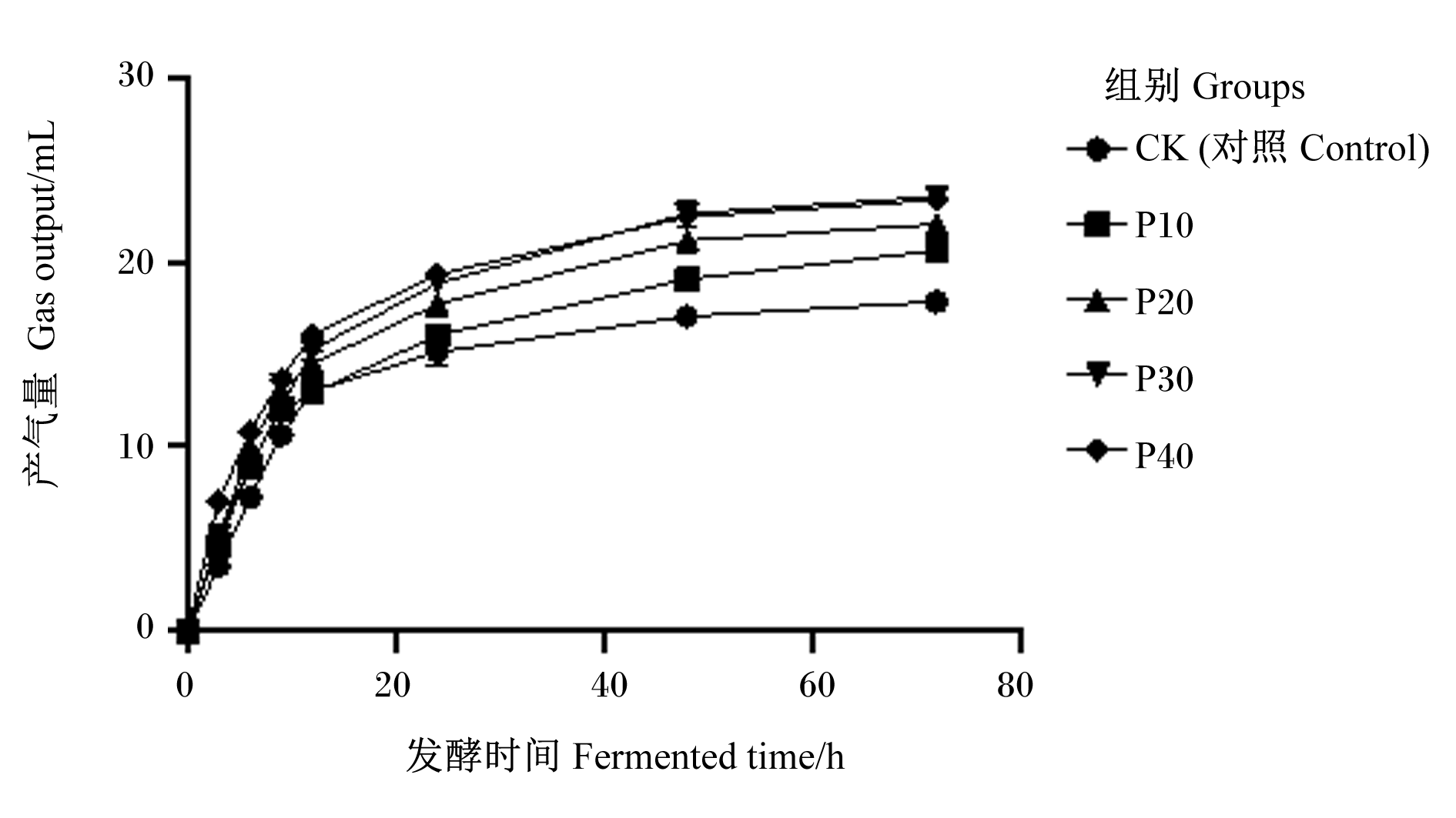
图1所示,72 h内的体外发酵产气量动态变化表明,产气量在24 h内迅速增加,之后趋于平稳。由表5可知,随着PESMS添加比例的增加,72 h累积产气量和理论最大产气量呈显著的线性增加和二次曲线变化(P<0.05),均在P30组达到最大值,且P10、P20、P30和P40组的72 h累积产气量和理论最大产气量显著高于CK组(P<0.05)。随着PESMS添加比例的增加,产气速率常数和产气滞后时间呈显著的线性和二次曲线变化(P<0.05);P10、P20、P30和P40组的产气速率常数显著低于CK组(P<0.05);P10、P20、P30和P40组的产气滞后时间均为负值,显著低于CK组(P<0.05)。
图1 体外发酵产气量动态变化

Fig.1 Dynamic changes of gas production of in vitro fermentation

表5 水稻秸秆与不同比例PESMS混合青贮的体外发酵产气量和产气参数分析

Table 5 Analysis of gas production and gas production parameters in in vitro fermentation of mixed silage of rice straw with different proportions of PESMS

项目
Items
组别 Groups SEM PP-value
CK(对照
Control)
P10 P20 P30 P40 方差分析
ANOVA
线性
Linear
二次
Quadratic
72 h累积产气量
72 h cumulative gas
production/mL
17.87d 20.63c 22.06b 23.57a 23.40a 0.571 <0.001 <0.001 <0.001


产气参数
Gas
production
parameters
理论最大产气量
Theoretical maximum
gas production/mL
17.28d 19.83c 21.47b 23.25a 22.99a 0.601 <0.001 <0.001 <0.001
产气速率常数
Gas production rate
constant/(mL/h)
0.12a 0.08b 0.09b 0.08b 0.08b 0.003 <0.013 0.016 0.009
产气滞后时间
Gas production
Lag time/h
1.05a -0.90bc -0.43b -0.29b -1.69c 0.263 <0.001 0.004 0.016

2.4 水稻秸秆与不同比例PESMS混合青贮的体外发酵参数分析

表6可知,随着PESMS添加比例的增加,除pH外的其他发酵指标均呈显著的二次曲线变化(P<0.05)。P20组的NH3-N、MCP含量和乙酸/丙酸最高,显著高于其他各组(P<0.05)。P20组的总挥发性脂肪酸(TVFA)含量最高,且P10、P20和P30组的乙酸、丙酸、丁酸、异丁酸、异戊酸、戊酸及TVFA含量显著高于CK和P40组(P<0.05)。
表6 水稻秸秆与不同比例PESMS混合青贮的体外发酵参数分析

Table 6 Analysis of in vitro fermentation parameters of mixed silage of rice straw with different proportions of PESMS

项目
Items
组别 Groups SEM PP-value
CK(对照
Control)
P10 P20 P30 P40 方差分析
ANOVA
线性
Linear
二次
Quadratic
pH 6.51b 6.55a 6.47d 6.54a 6.49c 0.008 <0.001 0.414 0.667
氨态氮 NH3-N/(mg/dL) 21.14d 31.48b 34.49a 23.72c 18.93d 1.641 <0.001 0.312 <0.001
乙酸 Acetic acid/(mmol/L) 51.77d 77.16b 82.43a 71.65c 42.07e 4.175 <0.001 0.419 <0.001
丙酸
Propionic acid/(mmol/L)
15.60b 21.59a 21.91a 21.96a 12.82c 1.047 <0.001 0.503 <0.001
异丁酸
Isobutyric acid/(mmol/L)
0.91c 1.62a 1.49b 1.37b 0.81c 0.087 <0.001 0.508 <0.001
丁酸
Butyric acid/(mmol/L)
6.31d 9.47b 10.47a 8.30c 5.21e 0.530 <0.001 0.396 <0.001
异戊酸
Isovaleric acid/(mmol/L)
1.58c 2.69a 2.72a 2.24b 1.41c 0.149 <0.001 0.464 <0.001
戊酸
Valeric acid/(mmol/L)
0.98d 1.69a 1.49b 1.30c 0.76e 0.092 <0.001 0.243 <0.001
乙酸/丙酸
Acetic acid/propionic acid
3.33c 3.58b 3.77a 3.26c 3.44c 0.057 <0.001 0.323 0.015
总挥发性脂肪酸
TVFA/(mmol/L)
77.15c 114.22a 120.51a 106.87b 63.08d 6.035 <0.001 0.426 <0.001
微生物蛋白
MCP/(mg/mL)
0.61c 0.71b 1.22a 0.59d 0.58d 0.065 <0.001 0.685 0.026

2.5 水稻秸秆与不同比例PESMS混合青贮的体外发酵营养物质降解率分析

表7可知,随着PESMS添加比例的增加,干物质体外降解率(IVDMD)、粗蛋白质体外降解率(IVCPD)、中性洗涤纤维体外降解(IVNDFD)和酸性洗涤纤维体外降解率(IVADFD)均呈显著的线性和二次曲线变化(P<0.05)。P30和P40组的IVDMD和IVCPD显著高于其他各组(P<0.05),P10、P20、P30和P40组的IVNDFD显著高于CK组(P<0.05)。
表7 水稻秸秆与不同比例PESMS混合青贮的体外发酵营养物质降解率分析

Table 7 Analysis of nutrient degradation rates in vitro fermentation of mixed silage of rice straw with different proportions of PESMS %

项目
Items
组别 Groups SEM PP-value
CK(对照
Control)
P10 P20 P30 P40 方差分析
ANOVA
线性
Linear
二次
Quadratic
干物质体外降解率 IVDMD 54.36b 55.35b 55.97b 63.14a 64.91a 1.333 0.003 <0.001 <0.001
粗蛋白质体外降解率 IVCPD 60.58b 65.10b 63.60b 76.02a 77.30a 1.988 <0.001 <0.001 <0.001
中性洗涤纤维体外降解率
IVNDFD
34.01c 37.92b 38.11b 42.96a 41.60ab 0.960 0.004 <0.001 0.001
酸性洗涤纤维体外降解率
IVADFD
28.24 31.52 33.96 35.08 33.79 0.914 0.105 0.017 0.015

3 讨论

水稻秸秆粗纤维含量高,而CP和水溶性碳水化合物含量较低,营养价值有限[21]。为提高水稻秸秆青贮的营养成分和发酵品质,通常会在青贮过程中添加农业副产物,并与秸秆进行混合青贮,以改善饲料的可利用性和发酵稳定性。已有研究表明,菌糠与玉米秸秆混合青贮可提高CP含量,同时NDF和ADF在发酵后得到一定程度的降解,从而提升混合青贮的整体可利用性[22]。为减少自然发酵差异对不同处理比较的干扰,试验中统一添加了在水稻秸秆青贮中已被广泛应用并证实具有稳定促发酵效果的复合菌剂作为发酵启动条件[23],使各处理在相对一致且可控的发酵背景下进行比较。通过梯度设计,本研究旨在明确在保持稳定发酵条件下,PESMS的最优添加比例,为秸秆青贮的高值化利用提供可操作的参考。

3.1 PESMS添加比例对混合青贮营养组成的改善作用

农业副产物的高值化利用是可持续畜牧业的核心[24]。本研究将PESMS与水稻秸秆进行混合青贮,证实PESMS可有效改善混合青贮的营养结构。混合青贮中CP、Ca和P含量的提升,主要归因于PESMS自身富含这些养分,其添加直接提升了混合青贮的营养密度。该结果与已有研究中对菌糠混合青贮营养改善作用的报道相一致。例如,Kwak等[25]将菌糠与肉鸡垫料以不同比例混合青贮,显著提高了DM和CP含量;Rangubhet等[26]研究表明,金针菇菌糠在与尿素、全株玉米混合青贮后,可提升其营养价值。NDF和ADF含量是评价饲料中纤维质量优劣的重要指标[27]。本研究中,由于PESMS的NDF和ADF含量低于水稻秸秆,随着其添加比例提高,混合青贮的NDF和ADF含量降低。这种变化可能源于混合底物中结构性碳水化合物比例的重组。此外,食用菌栽培过程中分泌的纤维素酶等[28]可能对基质纤维进行了预降解,使得菌糠纤维结构更为疏松,从而在青贮过程中更易被微生物进一步利用。

3.2 PESMS添加比例对混合青贮发酵品质的影响

青贮发酵品质由pH、VFA及NH3-N等关键参数共同决定[29-30],直接影响饲料保存、营养价值,最终影响动物健康和表现[31],其核心在于通过微生物发酵快速建立并维持稳定的酸性环境。本研究显示,添加低至中等比例(10%~30%)的PESMS能够维持良好的发酵状态,表现为较低的pH和丁酸含量,这表明在此范围内,混合底物能支持乳酸菌的有效发酵;然而,当PESMS添加比例提高至40%时,发酵品质劣化,pH及NH3-N、丁酸含量异常升高。NH3-N含量升高表明蛋白质降解过度[32],而丁酸作为梭菌活动的标志物,其含量增加直接导致适口性下降和能量损失[33]。这种现象可能源于高比例PESMS添加导致发酵体系碳氮比失衡,可溶性碳水化合物含量不足[34],限制了乳酸菌迅速产酸与pH下降,从而为丁酸梭菌增殖提供了条件。

3.3 PESMS添加比例对混合青贮体外发酵产气量和产气参数的影响

体外发酵产气量是反映瘤胃微生物活动趋势的重要指标[33]。本研究通过产气动力学分析发现,CK组的产气滞后时间为正值,而PESMS添加组的产气滞后时间均有所降低甚至为负值。这一动力学参数的变化提示,添加PESMS可能有助于缩短瘤胃微生物对混合底物的发酵启动时间。随着PESMS添加比例的增加,72 h累积产气量和理论最大产气量均随PESMS添加比例的增加而升高,其添加可通过底物协同效应激活瘤胃微生物代谢,从而提升发酵系统的产能潜力。

3.4 PESMS添加比例对混合青贮体外发酵参数的影响

体外发酵参数是评价青贮饲料营养价值的关键依据。本研究中,P20组的NH3-N和MCP含量同时达到最大值,表明该PESMS添加比例下氮源的释放速率与微生物的蛋白质合成需求匹配度较高。同时,该组的VFA含量也最高,显示出在此添加比例下,体外发酵产生了更多的可利用能量物质。然而,当PESMS添加比例提高至40%时,尽管CP含量最高,但NH3-N、MCP和TVFA含量却降低,反映出瘤胃微生物代谢功能的整体紊乱。该现象与高比例葡萄渣抑制瘤胃发酵的报道[35]一致。内在机制可能与高添加比例PESMS改变了瘤胃微生物的代谢平衡有关,具体途径有待深入探究。

3.5 PESMS添加比例对混合青贮体外发酵营养物质降解率的影响

营养物质降解率是评价饲料营养价值重要的指标之一。本研究中,随着PESMS添加比例的增加,IVDMD和IVCPD持续上升,说明PESMS有效改善了混合青贮体系的整体可发酵性。这一结果与前述营养成分分析相符,表明PESMS的添加确实提高了底物的可降解性。然而,尽管P40组表现出最高的IVDMD和IVCPD,其TVFA和MCP含量却最低。这与Hamid等[36]关于红参副产物的研究发现类似,该研究也报道了红参副产物具有较高的IVDMD,但同时伴随着较低的VFA和NH3-N含量,以及显著升高的甲烷产量,可能表明营养物质更多地流向产气途径。本研究未测定具体气体成分,未来需通过测定甲烷产量及微生物群落结构等进行深入验证。

4 结论

本试验条件下,添加20%~30%的PESMS可有效提升水稻秸秆青贮的营养价值、发酵品质和体外发酵营养物质降解率。
[1]
SASU P, AKORLI D E, ASARE R, et al. Comparative nutritional evaluation of the leaves of Bambusa balcooa (Beema) and Oxytenanthera abyssinica (A. Rich.) Munro bamboos,and the straws of AGRA and AMANKWATIA rice varieties[J]. Cogent Food & Agriculture, 2023, 9(2):2263960.

[2]
寇江涛, 程钰, 张海波, 等. 不同酶制剂对水稻秸秆和白酒糟混合青贮品质的影响[J]. 草地学报, 2021, 29(2):396-401.

DOI

KOU J T, CHENG Y, ZHANG H B, et al. Effects of enzyme on mixed silage quality of rice straw and distiller’s grains[J]. Acta Agrestia Sinica, 2021, 29(2):396-401. (in Chinese)

[3]
HE L W, ZHOU W, XING Y Q, et al. Improving the quality of rice straw silage with Moringa oleifera leaves and propionic acid:fermentation,nutrition,aerobic stability and microbial communities[J]. Bioresource Technology, 2020, 299:122579.

DOI

[4]
YANTI Y, YAYOTA M. Effect of epiphytic lactic acid bacteria fermented juice inclusion on quality of total mixed ration silage of agricultural and food by-products[J]. Indian Journal of Animal Sciences, 2019, 89(9):1002-1008.

[5]
杨昊庭. 转化不同食用菌菌糠对白星花金龟幼虫生长发育的影响[D].硕士学位论文. 呼和浩特: 内蒙古农业大学, 2023.

YANG H T. Effects of transforming different ediblefungus chaff on the growth and development of Protaetia brevitarsis larvae[D].Master’s Thesis. Hohhot: Inner Mongolia Agricultural University, 2023. (in Chinese)

[6]
LOU Z M, SUN Y, BIAN S P, et al. Nutrient conservation during spent mushroom compost application using spent mushroom substrate derived biochar[J]. Chemosphere, 2017, 169:23-31.

DOI PMID

[7]
张勇, 陈骥, 张锋. 中国菌糠露天焚烧污染物排放时空分布特征[J]. 中国环境科学, 2020, 40(1):100-108.

ZHANG Y, CHEN J, ZHANG F. The spatiotemporal distribution of pollutant emissions from open burning of spent mushroom substrate in China[J]. China Environmental Science, 2020, 40(1):100-108. (in Chinese)

[8]
ZHANG Z H, YAN J K, QIN Y Y. Deep processing and comprehensive utilisation of edible mushroom resources[J]. International Journal of Food Science and Technology, 2024, 59(12):9559-9561.

DOI

[9]
袁国宏, 张立东, 段平平, 等. 食用菌菌糠作为反刍动物饲料的研究进展[J]. 家畜生态学报, 2023, 44(10):1-8.

YUAN G H, ZHANG L D, DUAN P P, et al. Advances in spent mushroom substrate as ruminant fodder[J]. Acta Ecologiae Animalis Domastici, 2023, 44(10):1-8. (in Chinese)

[10]
吕仁龙, 张雨书, 张祎, 等. 不同比例姬菇菌糠与王草混合在高水分条件下青贮效果及对体外消化的影响[J]. 饲料研究, 2022, 45(24):12-16.

LV R L, ZHANG Y S, ZHANG Y, et al. Ferment effect of king grass with different ratios of Agaricus blazei murillon in high-moisture fermentation conditions and its effect on in vitro digestibility[J]. Feed Research, 2022, 45(24):12-16. (in Chinese)

[11]
HORWITZ W. Official methods of analysis of the AOAC international[M]. 17th ed. Gaithersburg: AOAC International, 2000.

[12]
VAN SOEST P J, ROBERTSON J B, LEWIS B A. Methods for dietary fiber,neutral detergent fiber,and nonstarch polysaccharides in relation to animal nutrition[J]. Journal of Dairy Science, 1991, 74(10):3583-3597.

DOI

[13]
中华人民共和国国家市场监督管理总局, 中国国家标准化管理委员会. 饲料中钙的测定:GB/T6436—2018[S]. 北京: 中国标准出版社, 2018.

State Administration for Market Regulation, National Standardization Administration. Determination of calcium in feeds:GB/T 6436—2018[S]. Beijing: Standards Press of China, 2018. (in Chinese)

[14]
中华人民共和国国家市场监督管理总局, 中国国家标准化管理委员会. 饲料中总磷的测定分光光度法:GB/T6437—2018[S]. 北京: 中国标准出版社, 2018.

State Administration for Market Regulation, National Standardization Administration. Determination of phosphorus in feeds-spectrophotometry:GB/T 6437—2018[S]. Beijing: Standards Press of China, 2018. (in Chinese)

[15]
ZHAO G Q, WU H, LI L, et al. Effects of applying cellulase and starch on the fermentation characteristics and microbial communities of Napier grass (Pennisetum purpureum Schum.) silage[J]. Journal of Animal Science and Technology, 2021, 63(6):1301-1313.

DOI

[16]
冯宗慈, 高民. 通过比色测定瘤胃液氨氮含量方法的改进[J]. 畜牧与饲料科学, 2010, 31(6/7):37.

FENG Z C, GAO M. Improvement of the method for determining ammonia nitrogen content in rumen fluid by colorimetry[J]. Animal Husbandry and Feed Science, 2010, 31(6/7):37. (in Chinese)

[17]
MCDOUGALL E I. The composition and output of sheep’s saliva[J]. The Biochemical Journal, 1948, 43(1):99-109.

DOI

[18]
MENKE K H, RAAB L, SALEWSKI A, et al. The estimation of the digestibility and metabolizable energy content of ruminant feedingstuffs from the gas production when they are incubated with rumen liquor in vitro[J]. The Journal of Agricultural Science, 1979, 93(1):217-222.

DOI

[19]
FRANCE J, DIJKSTRA J, DHANOA M S, et al. Estimating the extent of degradation of ruminant feeds from a description of their gas production profiles observed in vitro:derivation of models and other mathematical considerations[J]. British Journal of Nutrition, 2000, 83(2):143-150.

DOI

[20]
MAKKAR H P, SHARMA O P, DAWRA R K, et al. Simple determination of microbial protein in rumen liquor[J]. Journal of Dairy Science, 1982, 65(11):2170-2173.

PMID

[21]
陶旭雄, 邓维, 何鑫, 等. 水稻秸秆青贮研究进展[J]. 江西畜牧兽医杂志, 2024(1):36-39.

TAO X X, DENG W, HE X, et al. Research progress of rice straw silage[J]. Jiangxi Journal of Animal Husbandry & Veterinary Medicine, 2024(1):36-39. (in Chinese)

[22]
李小冬, 于二汝, 洪莉平, 等. 玉米秸秆与金针菇菌糠不同混合比例对发酵全混合日粮营养品质和霉菌毒素含量的影响[J]. 畜牧与饲料科学, 2024, 45(2):20-28,34.

LI X D, YU E R, HONG L P, et al. Effects of different mixing ratios of corn straw and spent Flammulina velutipes substrate on nutritional quality and mycotoxin content of fermented total mixed ration[J]. Animal Husbandry and Feed Science, 2024, 45(2):20-28,34. (in Chinese)

[23]
王占鑫, 卢薇, 崔嘉芮, 等. 枯草芽孢杆菌和植物乳杆菌在青贮饲料中的应用[J]. 饲料博览, 2025(5):24-29.

WANG Z X, LU W, CUI J R, et al. Fermentation effects of Bacillus subtilis and Lactobacillus plantarum on silage[J]. Feed Review, 2025(5):24-29. (in Chinese)

[24]
ISLAM S, KHAN M R I. The Potentiality of major crop’s by products as livestock feed in Bangladesh—a review[J]. Advances in Animal and Veterinary Sciences, 2021, 9(12):2103-2115.

[25]
KWAK W S, JUNG S H, KIM Y I. Broiler litter supplementation improves storage and feed-nutritional value of sawdust-based spent mushroom substrate[J]. Bioresource Technology, 2008, 99(8):2947-2955.

PMID

[26]
RANGUBHET K T, MANGWE M C, MLAMBO V, et al. Enteric methane emissions and protozoa populations in Holstein steers fed spent mushroom (Flammulina velutipes) substrate silage-based diets[J]. Animal Feed Science and Technology, 2017, 234:78-87.

DOI

[27]
IRMAK M, KODAN N. The role and physiological effects of NDF and ADF in dairy cattle nutrition[J]. Veterinary Science Reports, 2025, 1(2):8-17.

[28]
HUANG L, SUN N, BAN L T, et al. Ability of different edible fungi to degrade crop straw[J]. AMB Express, 2019, 9(1):4.

DOI PMID

[29]
DONG J N, LI S Z, CHEN X, et al. Effects of Lactiplantibacillus plantarum inoculation on the quality and bacterial community of whole-crop corn silage at different harvest stages[J]. Chemical and Biological Technologies in Agriculture, 2022, 9(1):57.

DOI

[30]
HASHEMZADEH-CIGARI F, KHORVASH M, GHORBANI G R, et al. Interactive effects of molasses by homofermentative and heterofermentative inoculants on fermentation quality,nitrogen fractionation,nutritive value and aerobic stability of wilted alfalfa (Medicago sativa L) silage[J]. Journal of Animal Physiology and Animal Nutrition, 2014, 98(2):290-299.

DOI

[31]
KUNG L M Jr, SHAVER R D, GRANT R J, et al. Silage review:interpretation of chemical,microbial,and organoleptic components of silages[J]. Journal of Dairy Science, 2018, 101(5):4020-4033.

DOI

[32]
毛翠, 刘方圆, 宋恩亮, 等. 不同乳酸菌添加量和发酵时间对全株玉米青贮营养价值及发酵品质的影响[J]. 草业学报, 2020, 29(10):172-181.

DOI

MAO C, LIU F Y, SONG E L, et al. Effects of lactic acid bacteria inoculant level and ensiling time on nutritional value and fermentation quality of whole-crop maize silage[J]. Acta Prataculturae Sinica, 2020, 29(10):172-181. (in Chinese)

DOI

[33]
王子苑, 舒健虹, 吉玉玉, 等. 利用体外产气法评价精饲料与玉米秸秆青贮、象草、白刺花之间的组合效应[J]. 黑龙江畜牧兽医, 2025(9):141-150.

WANG Z Y, SHU J H, JI Y Y, et al. Combination effect evaluation of concentrate,corn straw silage,napier grass,and Sophora davidii using in vitro gas production method[J]. Heilongjiang Animal Science and Veterinary Medicine, 2025(9):141-150. (in Chinese)

[34]
武伟成, 肖定福, 陈一峰, 等. 杏鲍菇菌糠和植物乳杆菌对全株玉米青贮有氧稳定性和体外发酵特性的影响[J]. 草地学报, 2024, 32(2):646-653.

DOI

WU W C, XIAO D F, CHEN Y F, et al. Effects of the addition of Pleurotus eryngii mushroom bran and Lactobacillus plantarum on the aerobic stability and in vitro fermentation characteristics of whole corn silage[J]. Acta Agrestia Sinica, 2024, 32(2):646-653. (in Chinese)

[35]
SUESCUN-OSPINA S T, VERA N, ASTUDILLO R, et al. Effects of País grape marc inclusion in high and low forage diets:ruminal fermentation,methane production and volatile fatty acids[J]. Italian Journal of Animal Science, 2022, 21(1):924-933.

DOI

[36]
HAMID M M A, MOON J, YOO D, et al. Rumen fermentation,methane production,and microbial composition following in vitro evaluation of red ginseng byproduct as a protein source[J]. Journal of Animal Science and Technology, 2020, 62(6):801-811.

DOI

Outlines

/